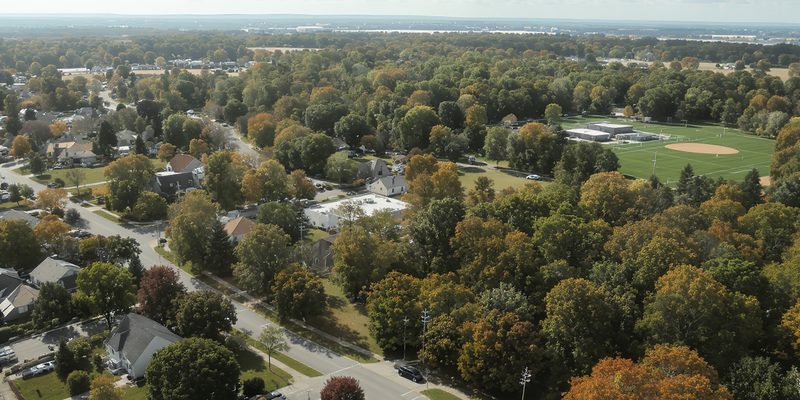
People relocating to the Philadelphia western suburbs almost always arrive with the same question, and it is the wrong one: which town is best? There is no best. There are ten or twelve genuinely good options, and the right one depends on where you will actually be driving every day, what you need from schools, and what you are willing to trade.
The commute is the first filter and the one people most consistently underestimate. King of Prussia, Malvern, and Blue Bell are three very different commutes even though they look close together on a map, and US-422 at 7:30 on a Tuesday morning is a different road than it is on a Sunday afternoon when you toured. If you will be commuting into Center City, the SEPTA regional rail lines matter enormously — the Paoli/Thorndale line through Exton and Malvern and the Lansdale/Doylestown line through Lansdale change the calculus entirely versus driving.
Schools are the second filter, and Pennsylvania's district boundaries do not follow municipal lines. It is entirely normal for two houses on the same street to feed different elementary schools, and for a township to be split across two districts. Buyers relocating from states where district equals town get caught by this constantly. Great Valley, Downingtown, Tredyffrin/Easttown, West Chester, Wissahickon, North Penn, Methacton, Spring-Ford, and Unionville-Chadds Ford are all strong and all different, and the boundary map is the document that matters, not the town name.
Then the texture of the places themselves, which no data set captures. West Chester and Phoenixville are walkable boroughs where you can leave the car. Blue Bell and Malvern are quiet, wooded, and car-dependent. Collegeville and Limerick are newer, more uniform, and more affordable per square foot. Norristown and Pottstown are urban boroughs with real value and real block-by-block variation. Kennett Square is its own world, closer to Wilmington than to Philadelphia in practice.
Property taxes also vary significantly by municipality and district, and a house that looks equivalently priced can carry a materially different monthly cost. That number belongs in the comparison from the start, not as a surprise at pre-approval.
The way I handle relocation clients is to spend the first conversation entirely on the constraints — job location, commute tolerance, school needs, budget, lifestyle — and then narrow to three towns before we look at a single house. Then we spend a day driving those three, at the time of day you would actually be driving them.
How the process actually runs
Constraints conversation
Job location, realistic commute, school requirements, budget, and what you're leaving behind that you want to keep.
Town shortlist
Three towns, with the honest tradeoffs for each rather than a brochure for all fourteen.
District and boundary check
We verify the actual attendance boundaries, because they don't follow town lines.
Orientation day
We drive the shortlist, including the commute at rush hour. This changes minds more than any listing sheet.
Search setup
MLS feed including coming-soon inventory across the shortlist, so nothing gets missed while you're still out of state.
Remote touring
Video walkthroughs on anything urgent so you're not flying in for a house that was wrong on arrival.
Offer and settlement
Coordinated with your relocation timeline, temporary housing, and any employer relocation benefit.
Let's talk
If you're moving here from out of the area, start the conversation early — even before the job is finalized. The orientation work is useful whether or not you end up buying with me.
Call or text (484) 744-9700, email mike@garymercerteam.com, or grab a time on my calendar.